There are books you read and think that’s interesting. And there are books you read and immediately want to hand to every parent, every teacher, and every school administrator you know.
Balanced and Barefoot: How Unrestricted Outdoor Play Makes for Strong, Confident, and Capable Children by Angela J. Hanscom is the second kind.
Who Is Angela Hanscom?
Hanscom is a pediatric occupational therapist and the founder of TimberNook, a globally recognized nature-based program that encourages children to engage with their environment through unrestricted outdoor play. She has contributed regularly to the Washington Post, spoken at Johnson & Johnson’s TED-style main stage event, and was recognized as a “creative genius” by the DIY Network and named a Hometown Hero in Glamour Magazine’s 2015 Woman of the Year Issue.
She’s not a parenting blogger with an opinion. She’s a clinician with data… and the data is hard to look away from.
What the Book Says
One in six children now have a developmental disability – a massive increase compared to previous decades. Far more children are struggling with problems related to attention, balance, strength, coordination, or sensory processing. There has also been a significant rise in cases of ADHD, and many kids are weaker than in previous generations with decreased stamina.
Hanscom’s argument (grounded in her clinical work) is that a significant driver of these trends is the dramatic reduction in outdoor, unstructured play in children’s lives. Kids are sitting more, moving less, spending more time indoors on flat surfaces under artificial lighting, and the developing nervous system is paying the price.
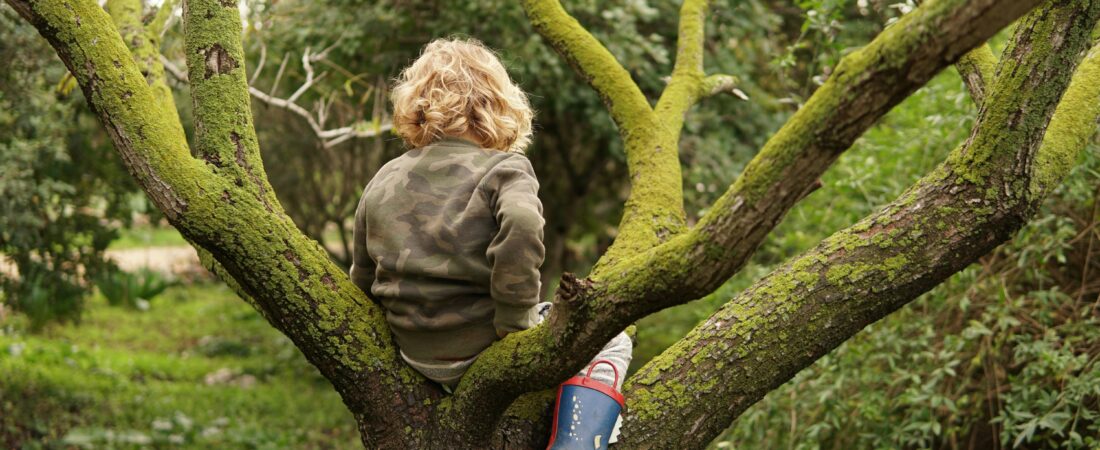
In Balanced and Barefoot, Hanscom makes a strong case for the multitude of benefits that come from allowing children the time and freedom to independently explore outdoors. Activities like climbing trees, getting muddy, and building forts foster children’s sensory, cognitive, and emotional-social development while also boosting creativity, physical health, and the ability to navigate risk.
One of the most eye-opening parts of the book involves two senses most parents have never considered. Beyond the familiar five senses, humans have two more: the vestibular sense (awareness of where your body is in space, vital for developing coordination and balance) and proprioception, the sensory awareness of where your body parts are without having to look at them. Hanscom contends that the outdoors is the best environment for developing both of these, through movement like hanging upside down, spinning, climbing, and navigating uneven terrain.
The barefoot piece is literal and important. True to its title, Balanced and Barefoot discusses the benefits of letting kids play outdoors without shoes… uneven ground allows immediate physical response and adaptation, developing foot muscles and whole-body balance in ways a flat, padded surface simply cannot.
Just within the first chapter, Hanscom traces decreasing core muscle strength, poor posture, decreased stamina, fragile bones, poor balance, weakened immune systems, aggression, reading difficulties, and anxiety as issues that stem from a nature deficiency. She’s not alarmist about it. She’s methodical. And she spends the rest of the book giving parents and educators real, practical strategies for bringing more outdoor movement back into children’s lives.
What Makes It Different
Hanscom draws on her professional experience as a pediatric occupational therapist and her personal experience as a parent, referencing diverse thinkers from biomechanist Katy Bowman to psychologist Peter Gray. If you are a parent or teacher struggling to support a child through a learning disability or sensory issue, you’ll find potentially valuable information and practical ideas. If you are an administrator or policy-maker working to balance competing demands on children’s time, Hanscom makes her case with stories of increased focus and reduced behavioral issues. The gem for many readers is the practical advice near the end – if your heart wants to embrace outdoor unstructured play but your mind has stalled making it a reality, the last three chapters are yours.
Why It Resonates
We live in the Finger Lakes. We have gorges, trails, lakes, fields, woods, and eleven bodies of water our kids could be learning to move through all summer long. We have exactly the kind of landscape Hanscom is describing when she says children need varied terrain, natural materials, and the freedom to take risks their bodies can handle.
Reading this book while living here feels almost like a permission slip… a clinician with a graduate degree telling you that the most important thing you can do for your child’s developing brain and body is to take them outside and get out of their way.
That’s not a hard sell in the Finger Lakes. But it’s a good reminder.
Balanced and Barefoot is available at your local library, on Amazon, and at independent booksellers. It’s a quick, readable book (not dense, not academic) and you’ll have finished it by the end of a summer weekend. Then you’ll hand it to someone else! 📚